


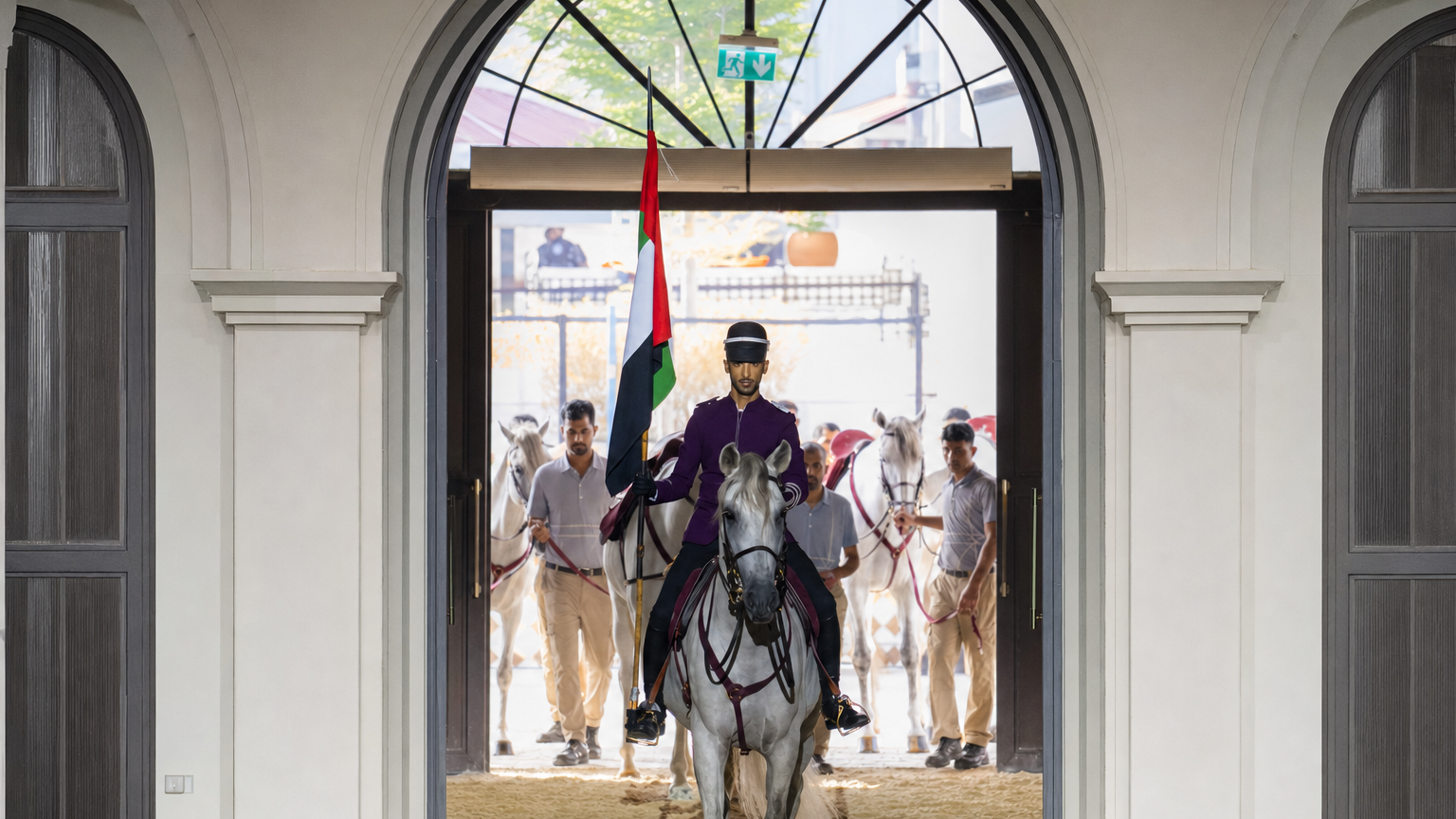


Abu Dhabi Royal Equestrian Arts (ADREA) opened its new season on September 12 2026 with a performance titled Furusiyya: The Return to Origins at its campus on Jubail Island the Abu Dhabi Media Office announced. The show features more than 40 pure Spanish-bred white stallions executing haute école movements such as the piaffe levade courbette and capriole alongside a synchronized eight-horse carousel sequence. An original score by composer Isa Najem and large-scale projections tracing Arab equestrian history accompany the 60-minute presentation which highlights harmony precision and trust between riders and horses. ADREA described the event as rooted in the Arab tradition of Furusiyya that emphasises discipline patience and mutual respect.
The performance opens a new chapter for ADREA which the Abu Dhabi Media Office identified as the world’s fifth school of classical horsemanship and the first established outside Europe. It aims to preserve Furusiyya as a living heritage by creating contemporary experiences of its knowledge values and artistry for new generations. The institution’s founding returns the practice to the Arabian region where the human-horse relationship has been cultivated for centuries according to the media office release. Riders trained under Chief Rider Gonzalo Marques Obeso deliver the choreography in a climate-controlled 1200-seat arena.
Sheikh Mansour bin Zayed Al Nahyan inaugurated ADREA in late October 2025 on the 65000-square-metre site amid Jubail Island’s mangroves a step documented by the Abu Dhabi Media Office. The campus includes the Furusiyya Gallery which houses one of the world’s largest collections of more than 173 rare artefacts and artworks spanning over 2000 years of equestrian history across civilisations. An equestrian library and the UAE’s first saddle-making atelier further support training academic study and craftsmanship that blend traditional techniques with modern methods. These facilities position ADREA as both an educational centre and public cultural destination.
Furusiyya literature originated in the Abbasid Caliphate with the ninth-century commander Ibn Akhi Hizam authoring early manuals on horsemanship veterinary care and mounted combat historical accounts referenced in ADREA materials show. The tradition peaked during the Mamluk Sultanate in the 14th century when treatises codified its role in military aristocracy and sport across the Middle East. ADREA’s gallery collection illustrates this evolution drawing connections between Arab practices and parallel developments in Eastern and Western equestrian arts. Such context underpins the performance’s narrative arc from ancient civilisations to present-day heritage.
Visitors to the performance gain access to ADREA’s wider campus experiences including dining at outlets such as Knead Bakery SALT and Falwa by Emirati chef Faisal Alharmoodi the Abu Dhabi Media Office noted. Guided tours on other days open the stables gallery and library to the public providing deeper insight into the institution’s operations. Tickets begin at 150 dirhams with arena doors opening at 6pm for the 7pm show and the programme continues on selected Saturdays through late 2026 according to ticketing platforms. Late arrivals are not admitted once the performance begins.
The Furusiyya season forms part of Abu Dhabi’s cultural calendar that promotes traditional arts through public performances and educational programming. ADREA’s approach integrates the performance with opportunities to explore related crafts and history in a single location. Additional dates are listed for November and December 2026 at the same venue according to multiple event listings.