


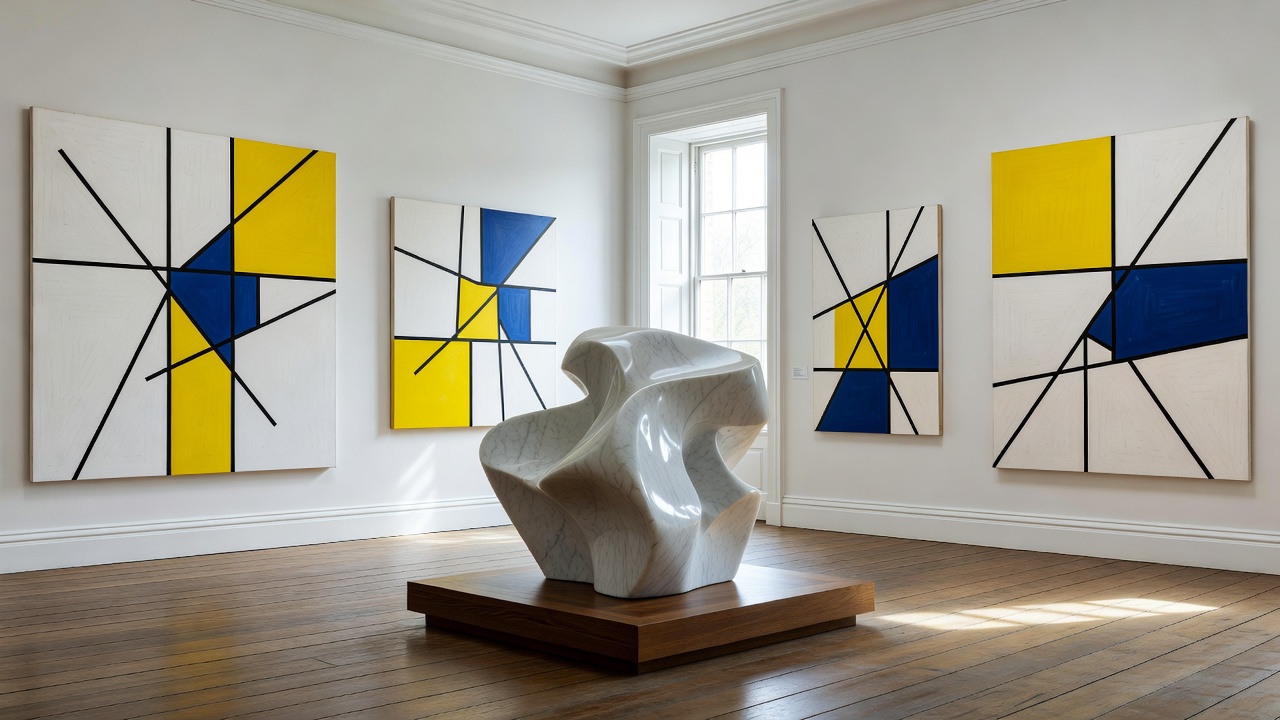


The exhibition Marlow Moss: Space, Movement and Light runs through 30 October at the gallery’s St James’s premises and draws its works exclusively from private collections, according to a report in The Art Newspaper. Ward Moretti described the presentation as the first commercial solo exhibition of the artist in London in more than 50 years, offering a rare opportunity to view pieces that are seldom accessible to the public. It includes the 1953 painting White, Yellow and Black on loan from a private owner and the marble sculpture Sculptural Form from around 1946, which Moss created as a gift for her partner following their wartime separation.
Born Marjorie Jewel Moss in London in 1889, the artist changed her name to the gender-neutral Marlow and adopted a masculine appearance after relocating to Cornwall in 1919, a transformation she later characterised as destroying her old personality to create a new one, The Art Newspaper reported. She moved to Paris in 1927, studying at the Académie Moderne with Fernand Léger and forming friendships with Constructivist figures including Georges Vantongerloo before meeting the Dutch writer Antoinette Nijhoff at the Café de Flore in 1929. Nijhoff introduced her to Piet Mondrian the same year, initiating a close professional relationship that continued until Mondrian left for New York in 1938, with their studios located only a few doors apart in Paris.
Moss originated the double-line motif in her paintings in 1930, a compositional device that Mondrian subsequently adopted after corresponding with her about the technique in 1932, according to recent art-historical reassessments. As a Jewish non-binary lesbian, she fled Nazi-occupied Europe and lost a substantial portion of her output in a 1944 studio fire in the Netherlands before settling again in Cornwall, where she continued working until her death in 1958. The relatively small number of surviving works has long limited scholarly and public engagement with her rigorous Neoplastic practice, which she summarised in a statement recalled by Nijhoff as focusing solely on space, movement and light rather than form.
Institutional acquisitions have accelerated in recent years, with the Rijksmuseum purchasing three of Moss’s pieces in 2023 and the National Gallery of Victoria acquiring one in 2025, a development noted across multiple exhibition announcements. The Centre Pompidou has also added a work to its collection, while the Georg Kolbe Museum in Berlin presented the artist’s first major German retrospective earlier in 2026, titled Creating Space: The Constructivist Marlow Moss and running from April to July. These shows have helped reposition Moss as an independent innovator rather than a mere follower of Mondrian, whose auction record stands at $51 million compared with Moss’s recent high of £1.18 million at Sotheby’s.

The London exhibition features additional works such as the 1952 Composition in Black, Blue and White, previously displayed at the Royal Festival Hall in 1955 and later at the Stedelijk Museum in Amsterdam, according to the accompanying catalogue. Another piece, White, Black, Yellow and Blue from 1954, was included in Moss’s 1958 Hanover Gallery exhibition and has since appeared at Tate Britain and Haus Konstruktiv. Gallery specialists emphasised the logistical challenge of organising the display given the concentration of her output in private hands and the historical gaps created by wartime losses.
Moss’s membership in the Abstraction-Création group from its founding in 1931 placed her alongside leading figures of international geometric abstraction, including Naum Gabo and Kurt Schwitters, a context explored in the exhibition’s supporting material. Her sculptures, which she termed constructions, receive particular attention through the single example on view, reflecting an aspect of her practice that gained renewed focus in the Berlin retrospective. Further loans and documentation in the show underline her exacting approach, which combined scientific precision with an uncompromising commitment to non-representational form.