




The Borgo, a collaboration with Jērra listed in Alserkal’s What the Food programme, connects vintage objects, hospitality and the way designed spaces are experienced.
A design object changes meaning when it leaves a photograph and enters a room where people gather. At Alserkal Avenue, Studio Meshary AlNassar’s collaboration with Jērra places that relationship at the centre of The Borgo, an activation combining vintage finds, curated objects and hospitality.
The project appears in Alserkal’s programme for 1 November 2026, at Warehouse 22. Its description invites visitors to spend time among objects intended to be lived with. That makes it a small but revealing part of the wider What the Food programme, where food, memory and the spaces around a shared table are considered together.
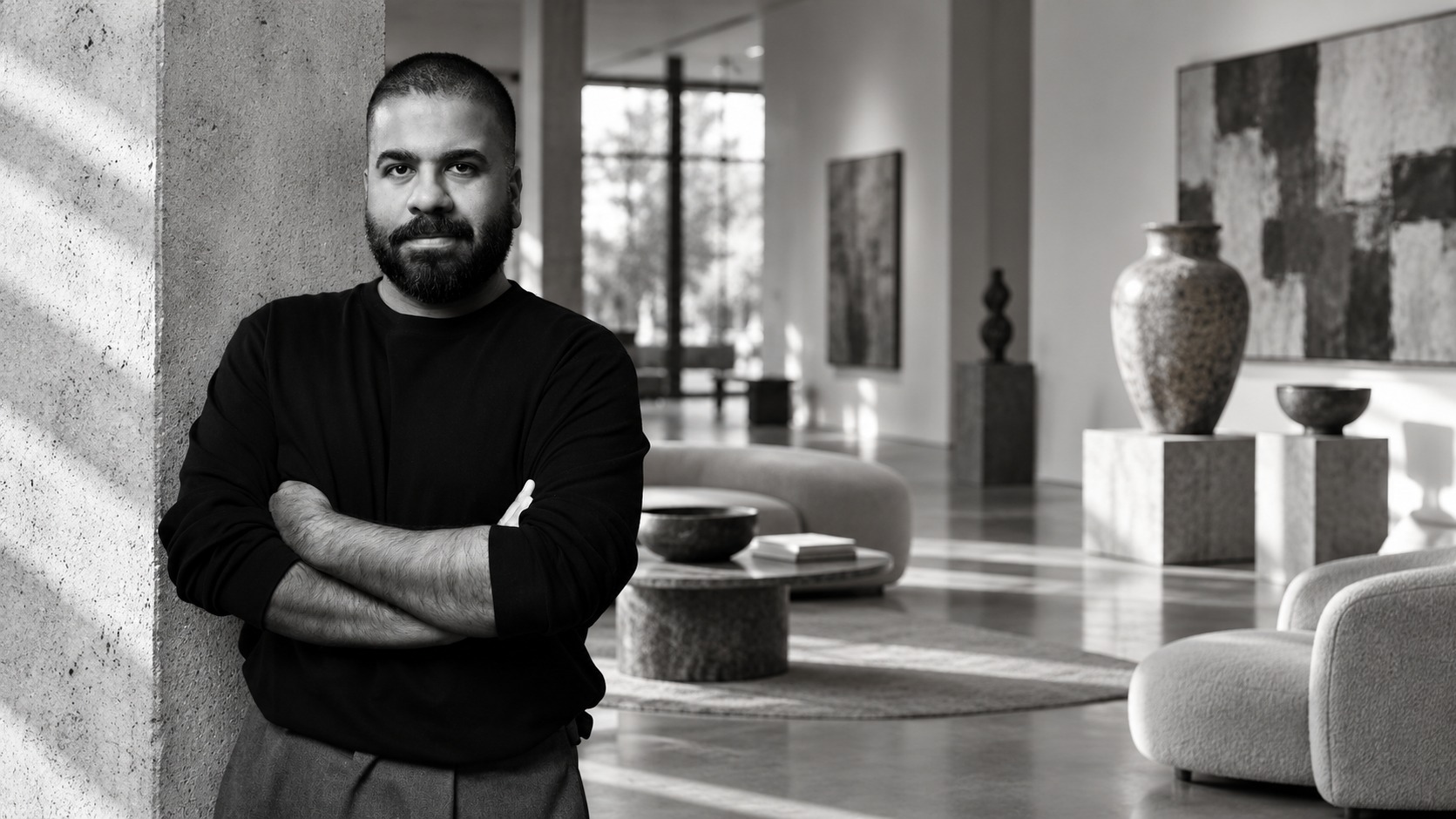
For Kuwaiti designer Meshary AlNassar, the setting connects two parts of his practice: designing complete environments and selecting the objects that give those environments their character. The event provides a public way into that relationship without requiring visitors to encounter the studio through a private residential commission.
From Kuwait to a public design address
Studio Meshary AlNassar was founded in Kuwait in 2018 and is now headquartered in Dubai. The practice describes its work as spanning architecture, interiors, landscape and product design. Its portfolio covers residential, hospitality, commercial and developer-led work, with the disciplines treated as connected parts of a project.
That range helps explain why a gathering built around objects belongs within the studio’s activity. A chair or vessel is not only a finishing touch when a practice is concerned with how people occupy a space. It can help determine how long someone stays, what they notice and how the room is used. The connection is an interpretation of the studio’s integrated approach, rather than a claim about the effects of any one project.
The Alserkal community directory places the studio at Warehouse 22. A public address within an arts district creates a different encounter from viewing a finished interior online. Visitors can meet the practice through its physical setting and programme, while the work sits alongside galleries, retailers and other cultural spaces.
Objects within a lived setting
The Borgo’s combination of vintage finds and curated objects is important because it brings time into the discussion of interiors. A vintage piece carries a previous life, while its placement in a contemporary environment gives it a new relationship to surrounding materials and uses. That does not establish its provenance, rarity or investment value, but it changes how a visitor can read the room.
In this setting, collecting becomes a question of arrangement as much as acquisition. An object can be considered in relation to light, proportion, texture and the other things beside it. The event’s premise allows those relationships to be encountered together, which is different from selecting each item through an isolated product image.
Hospitality provides the link between the display and the visitor. A gathering asks a designed environment to accommodate people as well as objects. That is a useful editorial lens for The Borgo: the room is being presented as a place for spending time, with design and social experience considered in the same frame.
A festival that gives food a wider frame
Alserkal’s What the Food programme places the activation alongside discussions, workshops and screenings. The programme includes a conversation about maleh, the Emirati tradition of salt-cured fish, and a textile workshop led by Nour Hage exploring recipes and memory. These are specific examples of food being treated as cultural material rather than only something served.
That context gives The Borgo a stronger rationale than the language of a standalone shopping event. Its attention to gathering sits within a programme concerned with what meals preserve, how practices travel and how objects and spaces hold social meaning. The connection is thematic, not evidence that every participant shares one artistic position.
For a visitor moving between the programme’s activities, the studio becomes one part of a broader discussion. A preserved ingredient, a remembered recipe and a vintage object each bring something from an earlier setting into present use. Their histories are different, but placing them within the same festival opens a conversation about continuity without requiring every object to become a museum piece.
A temporary activation also creates a different record from a permanent interior. It can be understood through its stated concept, location and programme without assuming how visitors responded. That leaves room for a subsequent account based on the objects actually shown and the conversations that took place, rather than treating the event description as a completed review.
A practice made visible beyond its commissions
The studio’s press archive records recent attention to its gallery format, alongside earlier work in interiors and product design. The archive is the practice’s own account of coverage, but it shows how the public-facing space has become part of the story it presents about its work.
The distinction between a studio, a gallery and a place of hospitality need not disappear for those uses to inform one another. A design practice can expose its way of seeing through a temporary arrangement, while visitors can respond to the space without commissioning a project or treating every object as a purchase.
The Borgo’s immediate contribution is therefore specific. It puts AlNassar’s interest in complete environments into a public programme, where objects are encountered through gathering and use. For a practice that began in Kuwait and now works from Dubai, the event offers a grounded view of its regional development: one room, one collaboration and a direct encounter between design and the people it accommodates.