


As a new Dubai exhibition explores how life in the Gulf is remembered, Khulood Al Jabri’s paintings offer a perspective shaped by women, family traditions and four decades in the UAE’s art institutions.
Khulood Al Jabri is among the artists taking part in A Way Through: Archive of Resilience, which opened at Dubai’s Kutubna Cultural Center on 3 October. Bringing together more than 40 artists and contributors, the exhibition asks how the experiences of people living in the Gulf will be recorded, and whose stories will form that record.
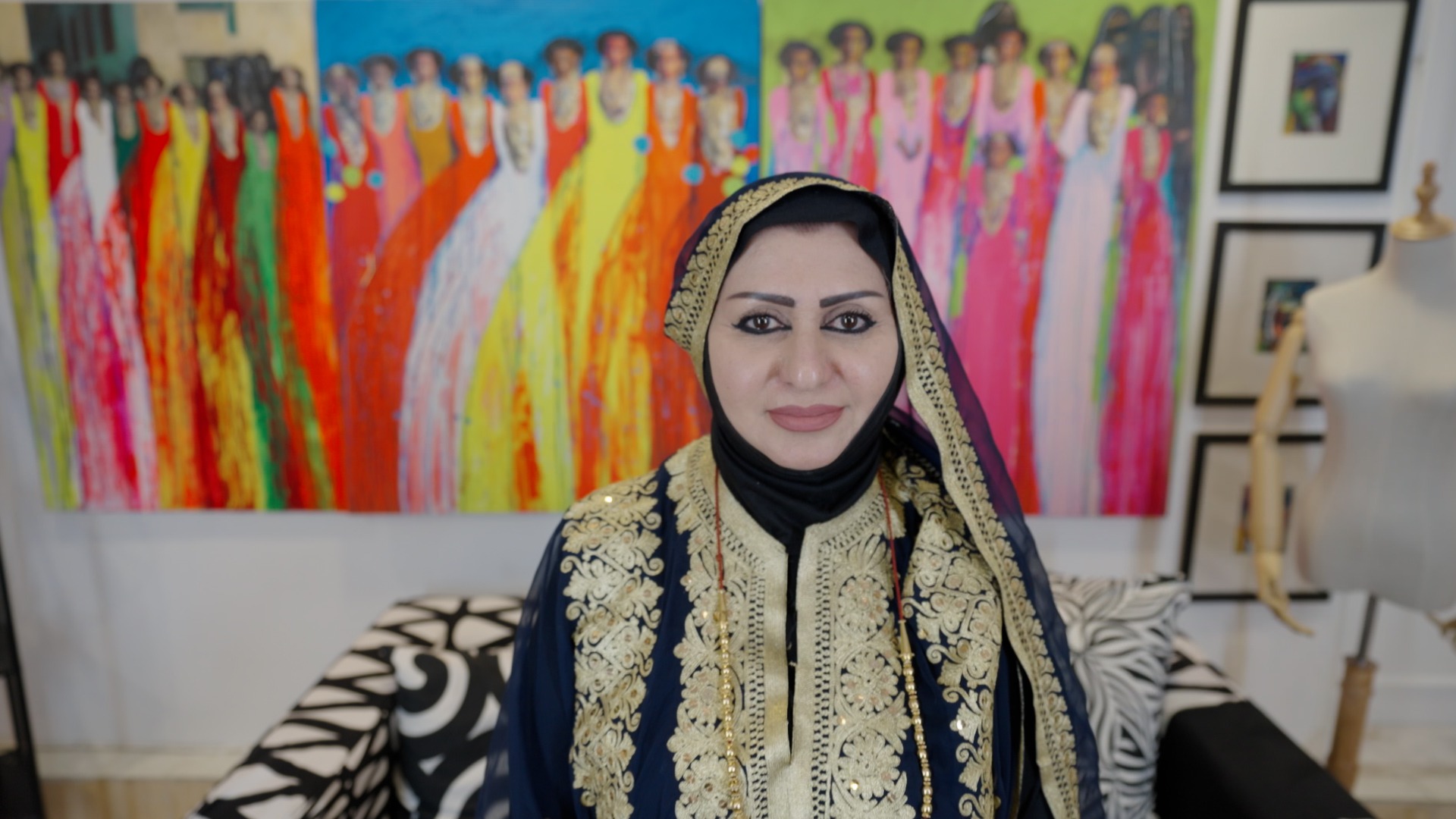
For Al Jabri, those questions connect with subjects that have long appeared in her practice. Emirati women, remembered gatherings and traditional dress have provided material for paintings that approach heritage through individual lives.
The Kutubna exhibition grew out of an oral-history initiative documenting culture in the Gulf during wartime. Its more than 70 works encompass painting, photography, textiles, writing and other forms. Al Jabri’s inclusion places an established Emirati practice within a wider, multigenerational attempt to preserve experiences that might otherwise remain private.
The women behind the paintings
In Al Jabri’s work, cultural memory often begins with the people closest to her. Her 2018 painting Al Tawmeena Ceremony drew on childhood memories of her mother and her mother’s friends, according to a 2019 interview with Villa88. The relationships between those women became a starting point for thinking about identity, companionship and the character of a gathering.
Her Burqa series approaches related questions through the traditional face covering. In Burqa’a Face 1, dated 2016, she combined acrylic, pastel and cotton on canvas. The choice of materials gives the subject a physical dimension beyond a painted likeness, bringing fabric into an image concerned with dress and identity.
In the same interview, Al Jabri connected her paintings with her hopes for Emirati women entering professions including medicine, aviation and the arts. That account offers a useful way to read her recurring female figures: they carry memories of earlier generations while also making room for changing ambitions. Tradition and the future occupy the same artistic territory.
A career shaped by Abu Dhabi’s cultural institutions
Al Jabri’s career also runs through the institutions where the UAE’s visual arts developed. In June 2026, Abu Dhabi Creative Centre recognised her contribution through its artist-career programme, looking back over more than four decades of practice.
Al Ittihad’s account of the event described her early involvement with Abu Dhabi’s Cultural Foundation, including teaching and work connected with its open studio and exhibitions. Her subsequent responsibilities included senior roles in the Ministry of Culture’s visual arts department and the Emirates Fine Arts Society.
These positions place her story within the practical work of sustaining an art scene: organising exhibitions, supporting workshops, assessing work and helping younger participants find their footing.
During the June discussion, she also traced an early interest in images to her father’s habit of collecting photographs. She recalled drawing from those photographs and turning them into paintings. That detail connects the public career with a domestic beginning, where collecting and looking came before the institutional roles.
When a painted face becomes a garment
Al Jabri’s treatment of women and heritage has extended beyond canvas. For a project initiated by Dr Reem el Mutwalli in 2018, she was one of five artists invited to paint on silk at an event celebrating Emirati women.
As The Zay Initiative documents, the painted pieces were subsequently made into garments combining the thawb and kandurah, preserved under the participating artists’ names in the organisation’s collection. Al Jabri painted a female face wearing the traditional burgu, using blue, black, purple, yellow and orange.
The resulting work brought together two ways of recording culture. A painted image could express the artist’s interpretation of a face, while the garment itself retained a relationship with the body, clothing and inherited forms of dress.
The project became part of Fanan: The Art of Dress, a collection involving five artists and five designers. Its significance lies in that movement between media: a familiar subject from Al Jabri’s painting entered a collection devoted to documenting Arab dress.
Artists remembering other artists
Memory also operates through relationships within the artistic community. Al Jabri participated in the Cultural Foundation’s The Tribute: A dedication to Najat Makki, which brought together 19 Emirati artists.
The exhibition invited responses to Makki through portraits and other painting approaches on large canvases. Its participants included artists who had studied alongside her, shared early exhibitions or exhibited with her internationally.
Such projects record connections that a list of individual achievements cannot fully convey. They show artists acknowledging the people with whom their practices developed. For Al Jabri, participation added another dimension to a body of work already concerned with the relationship between personal experience and shared history.
Preserving the person as well as the work
Al Jabri has also become the subject of an archive herself. She was one of 13 artists featured in Al Helm, a documentary series examined by The National in April 2025.
Directed by Elyan Mouarkesh, the films explored the artists’ memories, preferences and understanding of life. Al Jabri’s episode included her reflections on losing her mother, bringing the family relationships behind her practice into spoken testimony.
For viewers, that provides a different kind of access from an exhibition label. A painting can preserve a gesture, colour or remembered figure; a recorded conversation can retain the artist’s account of why those things mattered. Together, they offer a fuller record of a working life.
At Kutubna, that concern with what survives takes a collective form. A Way Through: Archive of Resilience runs until 7 December in Nadd Al Hamar, Dubai, with free admission and no booking required.