



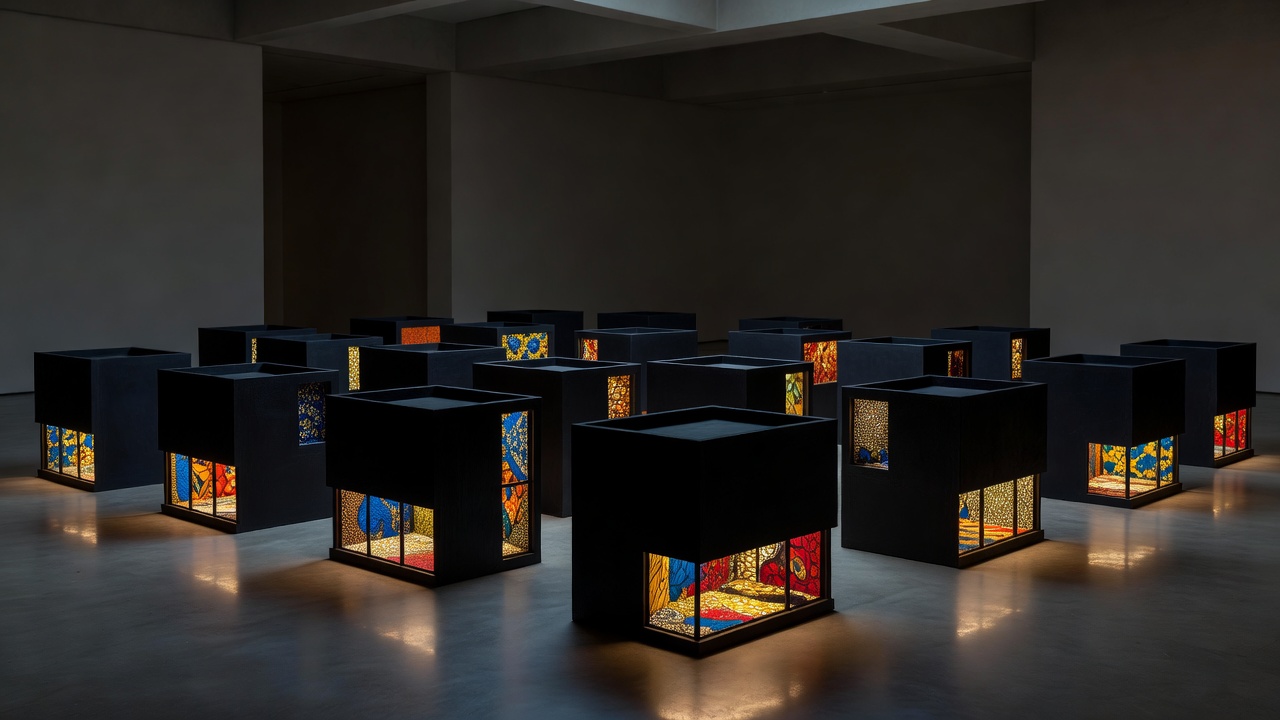


The Rose Art Museum at Brandeis University opened Yinka Shonibare: Sanctuary in February 2026 featuring the U.S. debut of the artist’s 2024 installation Sanctuary City. The work consists of 18 scaled-down replicas of buildings that have provided refuge to persecuted people throughout history according to the museum. Each structure is painted black and illuminated from within with interiors lined in the artist’s characteristic Dutch wax printed textiles creating a glowing effect in a darkened gallery space. The exhibition remains on view through January 3 2027.
British-Nigerian artist Yinka Shonibare created the installation to prompt reflection on who receives safety and who is excluded from it. Shonibare has said that shelter is one of the most pressing political concerns right now. The pieces reference specific sites such as the Temple of Athena in ancient Greece and the Hotel des Mille Collines in Rwanda during the 1994 genocide the museum reported.
Organized by Dr. Gannit Ankori the Henry and Lois Foster Director and Chief Curator at the Rose Art Museum the exhibition forms part of a season that also includes Photorealism in Focus. Ankori who is also a professor of fine arts and women’s gender and sexuality studies at Brandeis University selected the works to highlight both historical and contemporary notions of refuge. The display has drawn attention for its haunting embodiment of current global fears alongside messages of hope a review in the Boston Globe noted.
Founded in 1961 the Rose Art Museum has developed into one of the leading university art museums in the United States with a focus on modern and contemporary art Brandeis University data shows. The institution maintains free admission to support broad public access and integrates its programming with university academics. This approach has allowed the museum to address pressing societal issues through art while serving as an educational resource.
Exhibitions like Yinka Shonibare: Sanctuary align with the broader Arts and Culture – Brandeis University framework that emphasizes interdisciplinary dialogue and community engagement. The museum has scheduled accompanying events including a virtual tour and artist conversations to deepen visitor understanding. These programs have extended the exhibition’s reach beyond the gallery walls according to the museum’s event listings.
Interest in works by artists like Shonibare has grown as global discussions around migration and identity intensify. The Rose Art Museum’s presentation marks a significant opportunity for New England audiences to engage with the installation following its debut at the Serpentine in London. Museum attendance for similar contemporary shows has increased in recent years a trend observed across university-affiliated cultural institutions.