
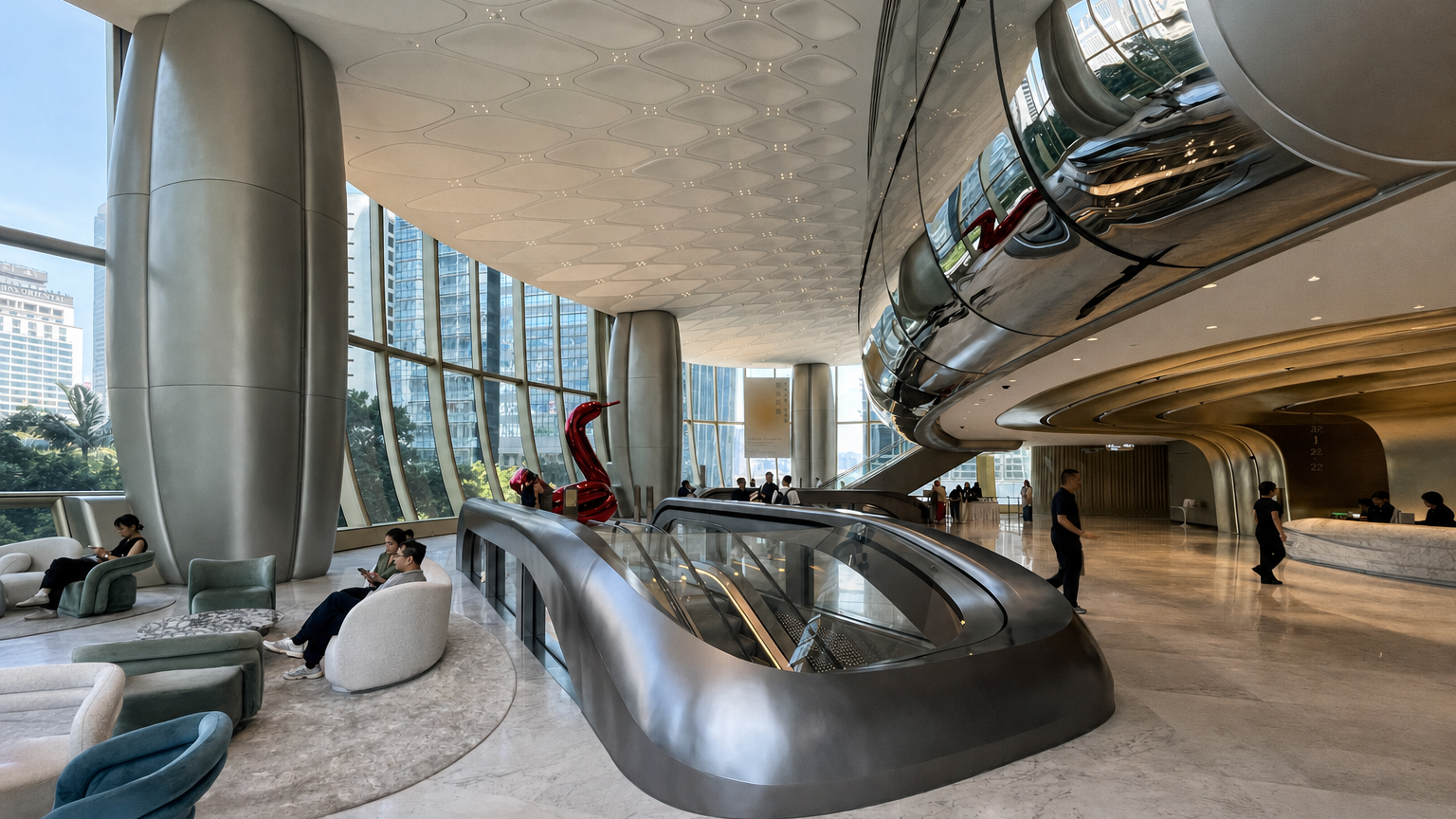


Christie’s launched the non-selling exhibition Through the Master’s Eye – David Hockney and Wu Guanzhong at its Asia Pacific headquarters in The Henderson on September 22, 2026, according to a report published by The Art Newspaper. The display features around seven works by British artist David Hockney, who died in June 2026, alongside 15 pieces by Chinese master Wu Guanzhong, all sourced from private collections. It runs through September 29 in tandem with previews for the house’s autumn 20th and 21st century art sales. The presentation marks the first time the two artists’ works have appeared together and the initial showing of Hockney pieces in Asia since his passing, a Christie’s press release issued on September 15 stated.
The exhibition draws its concept from Hockney’s three-week visit to mainland China and Hong Kong in 1981, a journey undertaken with Stephen Spender and Gregory Evans that shaped his later explorations of space and visual narrative. Chinese scroll paintings with their multiple perspectives left a lasting impression on the artist during that period of reopening, The Art Newspaper reported. Wu Guanzhong pursued a parallel path after studying at the École Nationale Supérieure des Beaux-Arts in Paris from 1947 to 1950, where he absorbed lessons from Cézanne, Van Gogh and Matisse before integrating them with Chinese traditions, according to details in the Christie’s announcement. The show highlights these converging influences through landscape themes that transcend their distinct cultural origins.
Two handscrolls by Qing dynasty artist Wang Hui, who lived from 1632 to 1717, occupy a central position in the exhibition to illustrate historical foundations for both modern practitioners. Wang Hui synthesised centuries of Chinese painting approaches with notable command of composition and shifting viewpoints, providing context for the dialogue between Hockney and Wu. “[Wang’s] work synthesised centuries of Chinese painting traditions while demonstrating remarkable mastery of composition, spatial organisation and narrative progression,” Cristian Albu said in comments reported by The Art Newspaper.
Cristian Albu, Christie’s deputy chairman and head of auction and private sales for 20th- and 21st-century art in Asia Pacific, framed the pairing as an opportunity to reveal common artistic concerns. Both creators devoted their careers to examining intersections between Eastern and Western traditions despite originating from separate backgrounds, he noted. “While they come from very different cultural backgrounds, both artists spent their careers exploring how Eastern and Western artistic traditions could inform one another and open up new ways of seeing the world,” Albu stated. “We felt there was a compelling opportunity to place their works in conversation and reveal these shared concerns to a contemporary audience.”
Public Authority for Cultural Affairs records and auction analyses from Artnet indicate that Wu Guanzhong’s pieces have maintained consistent market presence, with several oil and ink works achieving sales in Hong Kong events across 2026. Hockney’s vibrant, multi-panel landscapes such as The Big Hawthorn from 2008 have similarly commanded attention in international circles, particularly in the period following his death. The exhibition arrives as Christie’s marks both its 40th year in Asia and the 260th anniversary of its founding, integrating the display into a wider calendar of regional programming.
The free exhibition at 6/F The Henderson in Central encouraged visitors to examine how concepts of perspective evolve across cultures and eras, Christie’s said in its September 15 statement. It forms part of efforts to foster discussion on artistic exchanges that have shaped 20th-century practice in both Britain and China. Organizers positioned the show as a catalyst for additional research into these trans-regional connections, according to Albu’s remarks to The Art Newspaper.