


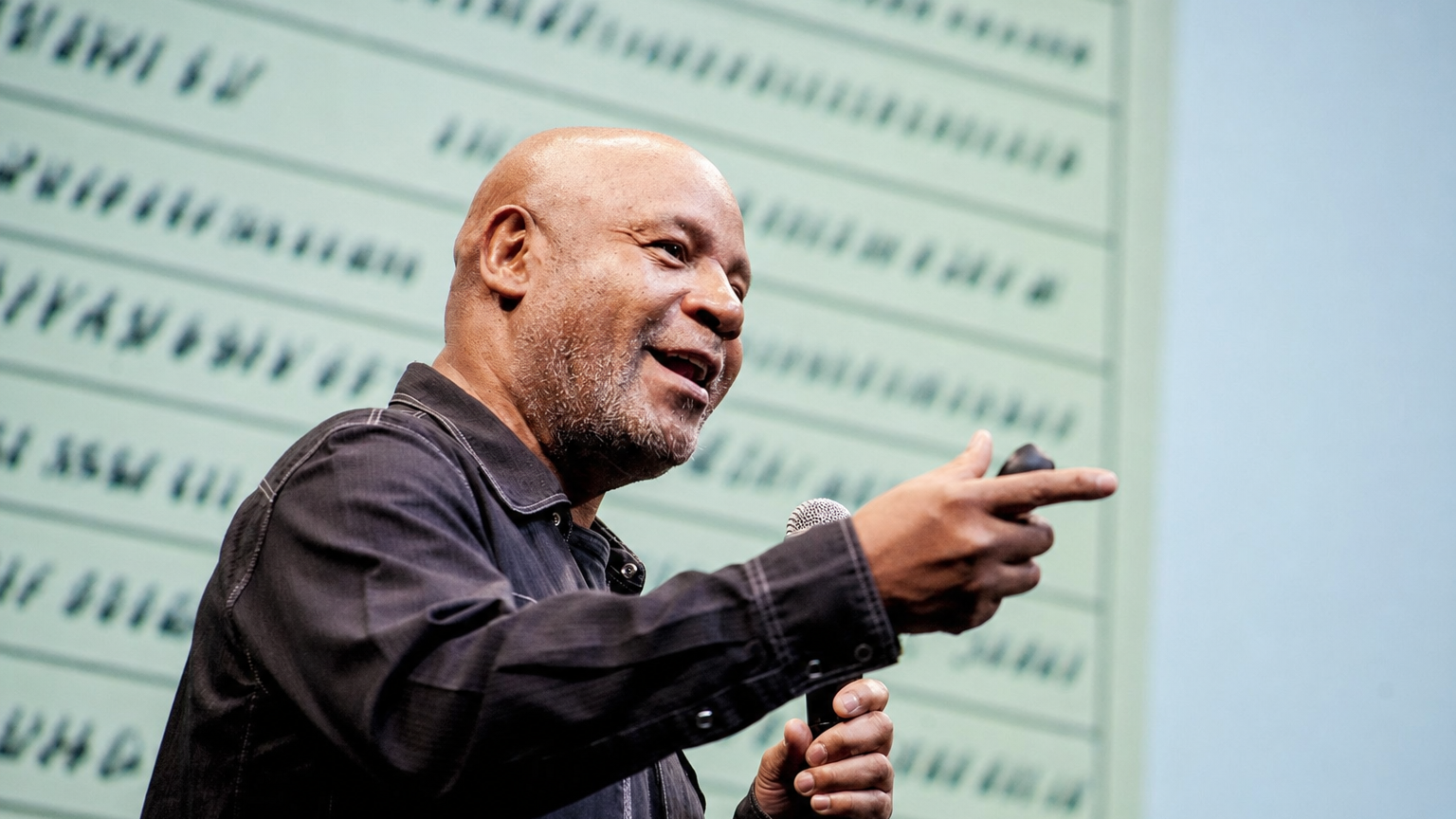


An interview with Emory Douglas, the Black Panther Party’s former minister of culture, explores how his artwork served to inform and mobilize communities rather than exist for aesthetic purposes alone, according to the San Francisco Bay View. Titled “Not just art for art’s sake: an interview with Emory Douglas, the Black Panther Party’s minister of culture,” the piece published on October 28, 2026, features interviewer JR Valrey discussing Douglas’s six decades of revolutionary visual art that has organized, educated and inspired Black and oppressed people globally. The artist’s political cartoons in the party newspaper reached both young readers and those who were illiterate, the publication reported. Douglas’s designs have been embraced by liberation movements worldwide, including in Algeria, Palestine, Cuba, Chiapas and China.
Speaking to the San Francisco Bay View, Douglas said his work meant informing, enlightening and educating people about the contradictions around the 10-point platform in relationship to the responsibility of revolution. He added that when Huey Newton described the Black Panther newspaper as the lifeblood of the party, it signified a lifeline to the world for sharing the party’s perspective. The newspaper enabled the group to tell its own story, criticize or praise events from the community and global viewpoints, Douglas told the outlet.
The Black Panther Party, founded in 1966, relied on Douglas’s visuals to articulate its calls for an end to police brutality and for community self-determination, a MoMA profile of the artist found. Douglas designed all but one of the party’s 537 newspapers between 1967 and the early 1980s, according to the Museum of Modern Art. Circulation peaked at nearly 140,000 copies weekly by 1971, the Society of Illustrators has documented.
A retrospective exhibition of Douglas’s work opened earlier in 2026 at San Francisco’s African American Art and Culture Complex, showcasing archival illustrations that addressed structural racism and police brutality, KQED reported. The show, titled “In Our Lifetime,” spans pieces from the 1960s and 1970s that accompanied captions highlighting government shortcomings on basic needs such as rent and groceries. Douglas served as the party’s minister of culture from 1967 to 1982, the exhibition review stated.
Douglas joined the Black Panther Party shortly after its founding, initially contributing his graphic design skills to produce impactful imagery using simple tools, BlackPast.org historical records indicate. His depictions of armed Black families and law enforcement as pigs became symbols of resistance that influenced subsequent generations of protest artists. Professor John Jennings credited Douglas with creating a visual language that continues to guide activism, a 2019 University of California Riverside news article quoted Jennings as saying.
In the San Francisco Bay View interview, Douglas clarified that his initial title was revolutionary artist before becoming minister of culture, a designation that Huey Newton and Bobby Seale deemed significant. He referenced experiences at the Black House cultural center in San Francisco as formative to his approach. The artist’s manifesto emphasized that art is a powerful tool to enlighten, inform and guide to action, according to a separate MoMA magazine article.