



From the old medina of Casablanca to exhibitions in London and Cape Town, Younes Khourassani has kept returning to the possibilities held within his materials. A photograph from 2012 captures an artist already finding his place among several generations of Moroccan painters.
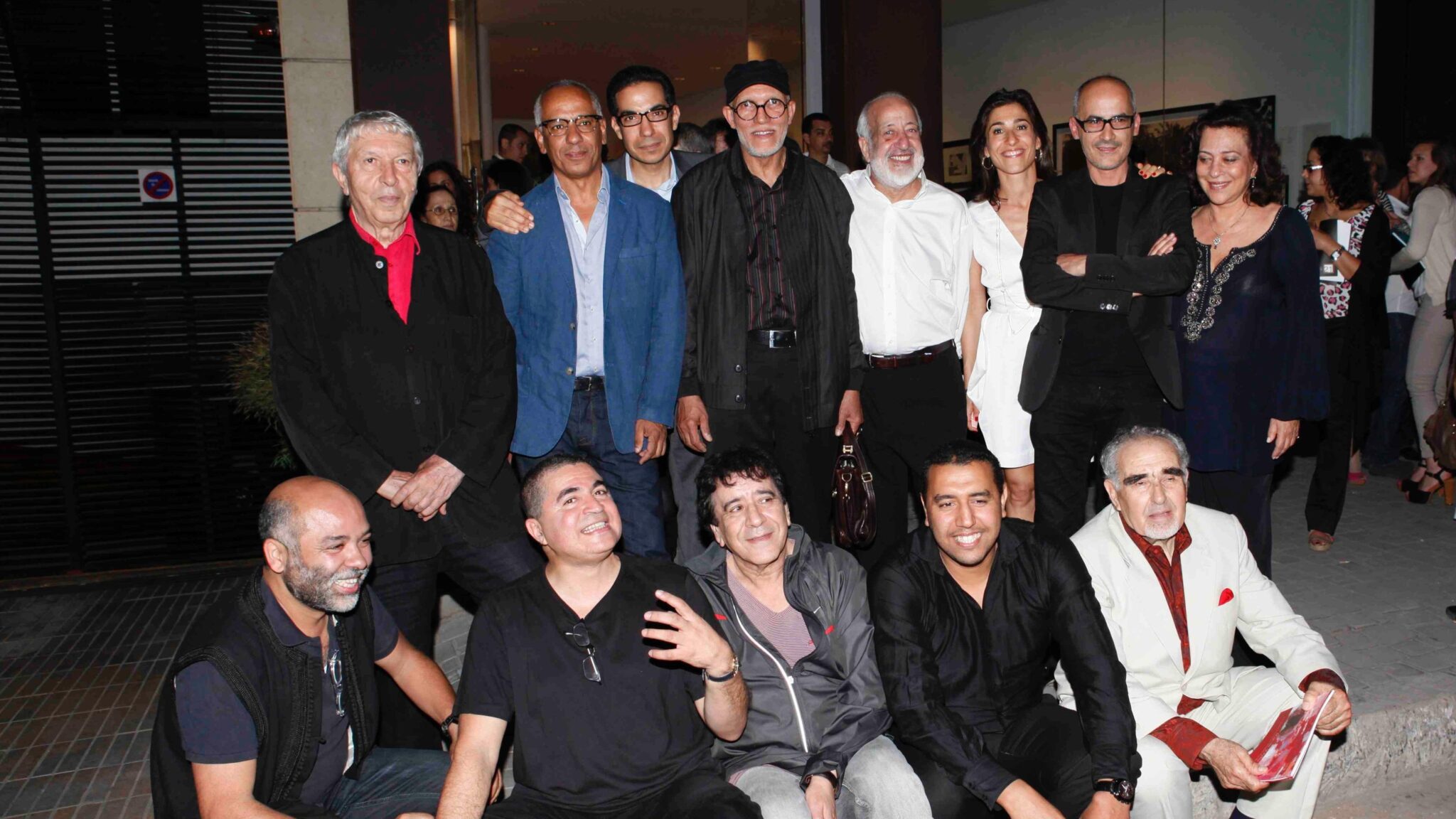
In a black-and-white photograph taken at L’Atelier 21 in Casablanca in 2012, Younes Khourassani sits between Houssein Miloudi and Saâd Ben Cheffaj, with Mahi Binebine nearby and Farid Belkahia standing behind. Gathered for the opening of Lignes sans brides, the artists belong to different generations of Moroccan painting. Khourassani, then in his mid-thirties, had already spent more than a decade developing a practice rooted in the materials and memories of the city where he grew up.
His work at the time included assemblages made from recovered musical instruments. Today, much of his painting is concerned with colour and the sensation of light. Between those two stages lies a career that has taken him through different media and exhibition settings, while sustaining an interest in what happens when something familiar begins to change. The photograph catches him partway through that journey, among artists whose own experiments had helped make such a path possible.
Learning to look in Casablanca
Born in Casablanca in 1976, Khourassani grew up in the old medina before entering formal art education at Lycée Jabir Ibnou Hayane. There he studied under Mohamed Hamidi, a member of the earlier generation of Moroccan modernists who became an important presence in his development. He went on to the city’s École des Beaux-Arts, graduating in 2001, according to his published biography.
Through Hamidi, his education connected him to a history that was still close at hand. The Casablanca artists had challenged inherited divisions between fine art, craft and everyday life, bringing their work into streets, publications and public buildings. That wider activity, documented in Sharjah Art Foundation’s account of the school, forms part of the background to Khourassani’s own willingness to work beyond conventional painting materials.
After graduation, he began making assemblages with metal, musical instruments and found objects. Each brought a different texture and shape into the work, but also a previous use. An instrument could retain its association with performance even after it had ceased to function as something to be played. Working with these objects meant responding to what was already there, then finding a new arrangement in which their familiar outlines acquired another meaning.
His professional life was also beginning to extend beyond Morocco. His career chronology records two presentations in Salmiya, Kuwait, in 2002, shortly after he completed his studies. The movement between local experience and audiences elsewhere would become a recurring feature of his career, even as the materials themselves changed.
The lives carried by objects
By January 2012, that early interest in recovered objects had developed into Langues de bois, his solo exhibition at L’Atelier 21. He had spent two years working with instruments that included lutes and violins collected from Casablanca’s entertainment venues. In the gallery’s original exhibition notes, the bodies of these instruments become faces, their raised forms and irregular surfaces still visible within the paintings.
One work pictured in the installation photographs shows a rust-brown figure against a pale ground, with a violin at its shoulder and a bow cutting diagonally across its body. The instrument projects from the painted surface. Nearby, other musicians emerge from dark backgrounds, their rough outlines built up around the objects they appear to play. Music enters these pictures through the physical presence of the instruments, giving the figures something of the weight and texture of the world outside the gallery.
Several months later, Khourassani returned to the same gallery for Lignes sans brides, which brought together 18 artists around drawing. The exhibition placed his work alongside that of established painters and younger contemporaries, connecting a shared medium with markedly different artistic approaches.
The group photograph was taken at that opening. By then, Khourassani had presented a solo exhibition and joined a group show that included several figures from the history of Moroccan modernism. His training had introduced him to that history through Hamidi; the recovered instruments had given him a subject through which to develop his own work. Both strands of his career were coming together in the same Casablanca gallery.
Following the work towards light
Over the following years, that concern with transformation gradually took on another form. His biographical account identifies the pandemic as a decisive period, when his attention turned increasingly towards light and the experience of looking. Colour became more central to the way his compositions were organised, carrying the movement that had previously depended on the arrangement of physical objects.
By 2022, this direction was reflected in exhibitions including Lumière Sacrée in Casablanca and La quête lumineuse at Abu Dhabi Art, both listed in his career history. The titles made his interest in light explicit. Depth and movement increasingly depended on the placement of one colour beside another, extending his experiments with what a painted surface could hold.
Yet the interest in objects continued alongside it. A La Galerie 38 report from November 2023 records a Paris residency connected with Infiniment Coty Paris and the 1-54 art fair, during which Khourassani created a work from perfume bottles. Presented at Somerset House in London, the project returned him to the challenge of giving a manufactured object another role, this time in a different material and setting.
His solo exhibition Energies of Light at Eclectica Contemporary in Cape Town, held from 5 to 27 February 2026, gave that direction a fuller public expression. The exhibition catalogue brings together paintings made in 2025 using cellulose paint on canvas, with titles including When the Heat Touches the Sky and Binary Orbits.
In When the Heat Touches the Sky, bands of yellow, orange and red curve towards deep blue and turquoise, meeting along a dark, twisting seam. The gradual changes in tone give the flat canvas the appearance of a folded surface. It is a different kind of construction from the earlier assemblages, made through successive areas of colour.
Seen alongside those instrument works, the Cape Town paintings make his development easier to follow. In Casablanca, a recovered violin gave a painted musician physical depth. Fourteen years after the group photograph, the projecting object had given way to an illusion created through colour: the canvas stayed flat while its surface seemed to fold.