
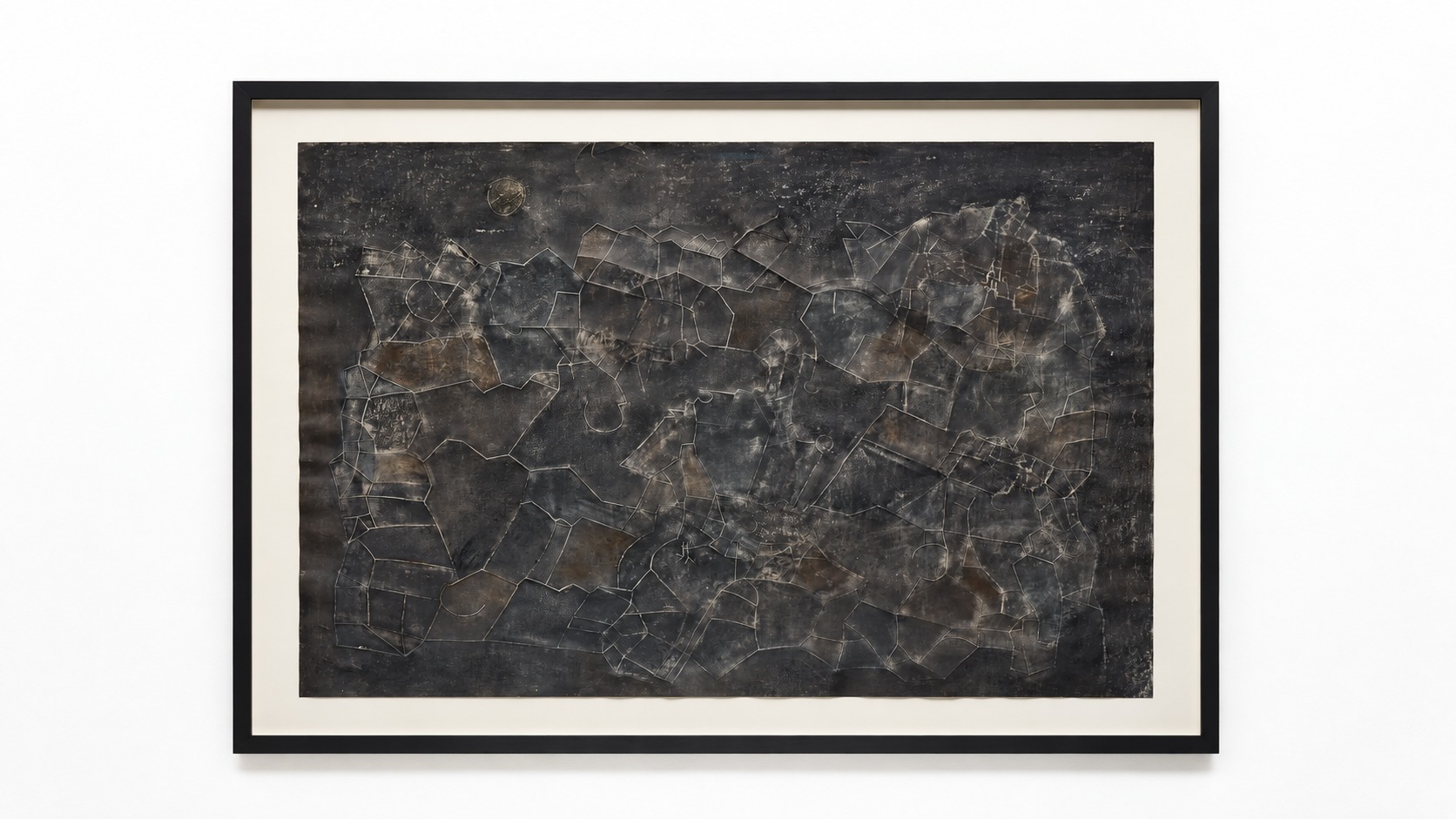


The Dubai gallery’s October presentation follows the artist’s movement between writing, landscape and portraiture, with a biography that includes three years in Kuwait.
Dubai gallery Lawrie Shabibi will present a solo booth of Maliheh Afnan’s work at Frieze Masters in London from October 14 to 18, bringing an artist whose life crossed Palestine, Lebanon, Kuwait, Europe and the United States into the fair’s examination of twentieth-century art. The presentation is being organised with the artist’s estate in the Spotlight section.
The gallery’s announced selection spans Afnan’s landscape and writing-related works of the 1970s and 1980s, alongside the figures she developed from the 1980s onwards. It offers a way to follow relationships between marks, places and faces across different periods, rather than treating her practice as a single approach to calligraphic abstraction.
Afnan died in 2016. A decade later, this presentation places her work within an international fair programme concerned with revisiting established accounts of modern art. For Gulf audiences, it also returns attention to an artist whose biography includes years in Kuwait and whose work is represented in a major Sharjah collection.
A life connecting Kuwait, Beirut and London
The Barjeel Art Foundation’s account of Afnan’s career records her birth in Palestine to Iranian parents, her education at the American University of Beirut and her postgraduate studies at the Corcoran School of Art in Washington. It places her in Kuwait between 1963 and 1966, followed by Beirut until 1974, Paris until 1997 and then London.
These movements give the forthcoming London presentation a Gulf connection extending beyond the location of the exhibiting gallery. Kuwait was one of the places in which Afnan lived during the development of her career, while Sharjah’s Barjeel collection holds her work and situates it within a wider history of Arab modernism.
The foundation identifies her painting Mindscape with a generation of Lebanese, Palestinian and Iranian women artists and writers who became prominent in the 1960s. It also records the role of American artist Mark Tobey in organising her first solo exhibition in Basel in 1971. That history makes an international reading of her work part of its development, rather than simply a later curatorial framework.
Writing that does not need to be read
Afnan’s use of marks resembling script grew from an early interest in the appearance of language. The Dalloul Art Foundation’s research describes her childhood fascination with official papers and bills in English, Hebrew and Arabic. Their visual forms mattered before she could read them.
The distinction remained central to her work. Lines could suggest writing without conveying a literal message. Dalloul describes her use of earthy colours, scratched surfaces and signs given the appearance of age. In relief works, she incised forms into plasticine before casting them in plaster and applying dark tones, connecting the act of making to the appearance of an excavated object.
Her portraits followed another route away from straightforward transcription. According to the foundation, the Personnages emerged without models: a line developed into a figure through memory and imagination. The faces therefore belong to the same inquiry as the scripts. Both can suggest a record of human experience without supplying the viewer with a fully identifiable person or readable statement. Paper’s varying absorbency and texture also affected how the marks took shape.
A solo presentation within a wider reassessment
Frieze’s September announcement identifies Devika Singh and Sofia Gotti, both academics at the Courtauld Institute of Art, as the curators of Spotlight. The section has formed part of Frieze Masters since its launch in 2012 and brings together focused presentations of twentieth-century artists from several continents.
The 2026 programme includes figures such as Indian painter Ganesh Haloi, South African artist Ernest Mancoba and Palestinian artist Afnan. It also includes Mohamed Melehi with Loft Art Gallery and Syed Sadequain with Grosvenor Gallery. That company gives the section a broader geographical frame than a survey organised around a single national school.
For Afnan, the solo format keeps the attention on how one practice changes across time. The gallery’s selected series place landscape, inscription and the human figure alongside one another. The reader need not reduce those shifts to a choice between regional tradition and international abstraction: her materials and recurring forms supply a more specific path through the work.
The Dubai gallery’s historical programme
Lawrie Shabibi was founded in 2010 and opened in Alserkal Avenue in early 2011. Its programme history describes an initial concentration on emerging contemporary artists from the Middle East and North Africa, followed by work with artists from additional regions and generations.
Historical exhibitions now sit alongside its contemporary programme. The gallery identifies presentations of Mohamed Melehi, Mehdi Moutashar and Mona Saudi among that work, including appearances at Frieze Masters, Abu Dhabi Art and Artissima. Afnan’s forthcoming booth belongs to this continuing strand of looking back at practices that developed before the Gulf’s present gallery infrastructure.
That relationship between a contemporary gallery and an artist’s estate is consequential for what reaches a fair audience. Selection can place separate periods in conversation, while published research supplies a record beyond the objects on view. In Afnan’s case, the October presentation brings her landscapes, inscriptions and figures together in London, a city that became her home in 1997. The works will be shown at The Regent’s Park during Frieze Masters, October 14–18.