



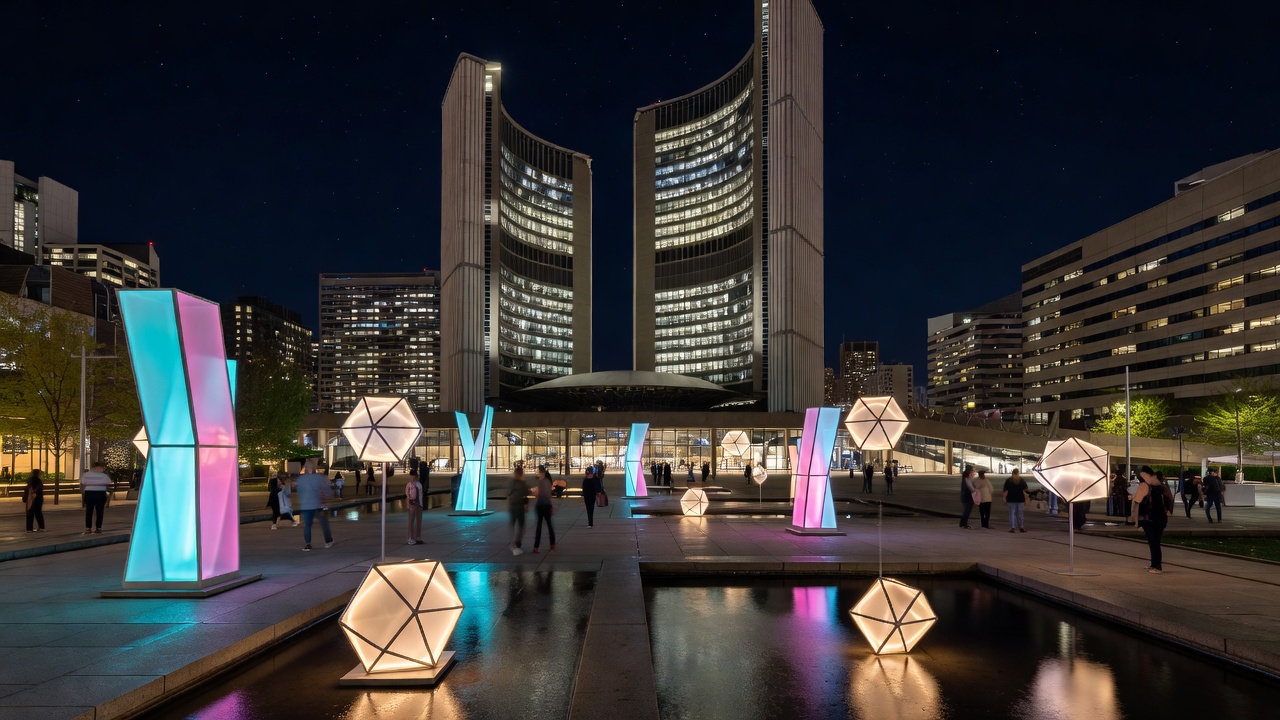


The City of Toronto announced that its annual Nuit Blanche festival launched on October 3 at 7 p.m. and ran through 7 a.m. on October 4, transforming public spaces into a free contemporary art exhibition for its 20th anniversary. This year’s theme, Tomorrow’s Memories, focuses on how art creates, preserves and reimagines shared experiences, according to a city news release from September. The event featured more than 70 projects including new commissions and remounts of iconic past works, with a central hub around Nathan Phillips Square and City Hall.
A City of Toronto assessment found that the 2026 edition included returning installations such as Kelly Mark’s Everything and Nothing from 2014, which features performers reciting phrases, and Couzyn van Heuvelen’s Avataq sculptures inspired by Inuit hunting tools. Brandon Vickerd’s UFO, a large-scale crashed flying saucer sculpture with lights and smoke at Queen Street West and University Avenue, formed part of the new works exploring cultural narratives. The city’s release listed additional participatory experiences and sound environments that invited audiences to reflect on nostalgia and belonging.
Toronto Times data shows that since its launch in 2006, Nuit Blanche has presented nearly 1,800 installations involving roughly 6,350 artists and generated more than $550 million in economic impact for the city. The 20th anniversary edition built on that legacy by blending historical pieces with forward-looking commissions, the publication reported. Organizers concentrated much of the programming in three exhibition zones while extending projects into neighbourhoods such as The Bentway and 401 Richmond.
City of Toronto figures indicate that the festival drew large crowds in previous years, with some editions attracting up to one million visitors. For 2026, the TTC operated all-night subway service on Lines 1 and 2 every 15 minutes from 1:30 a.m. to support attendees, according to the transit authority’s published schedule. Extended bus and streetcar routes supplemented the network during the overnight hours.

The City of Toronto release highlighted community partnerships with museums, galleries and cultural institutions that hosted one-night exhibitions and workshops in the lead-up to the main event. Jeanne Holmes, manager of city cultural events programming, discussed the anniversary in a CP24 interview, tying the programming to two decades of artistic experimentation across Toronto. Road closures took effect in downtown areas to accommodate the installations and foot traffic.
According to Destination Toronto, the free admission and citywide scope have made Nuit Blanche a signature event that showcases the city’s creative diversity. This year’s focus on memory and history included several works that remained on view past the all-night window, such as pieces at Nathan Phillips Square through October 10. The festival’s structure allowed visitors to follow curated routes or explore independently across the downtown core and beyond.