


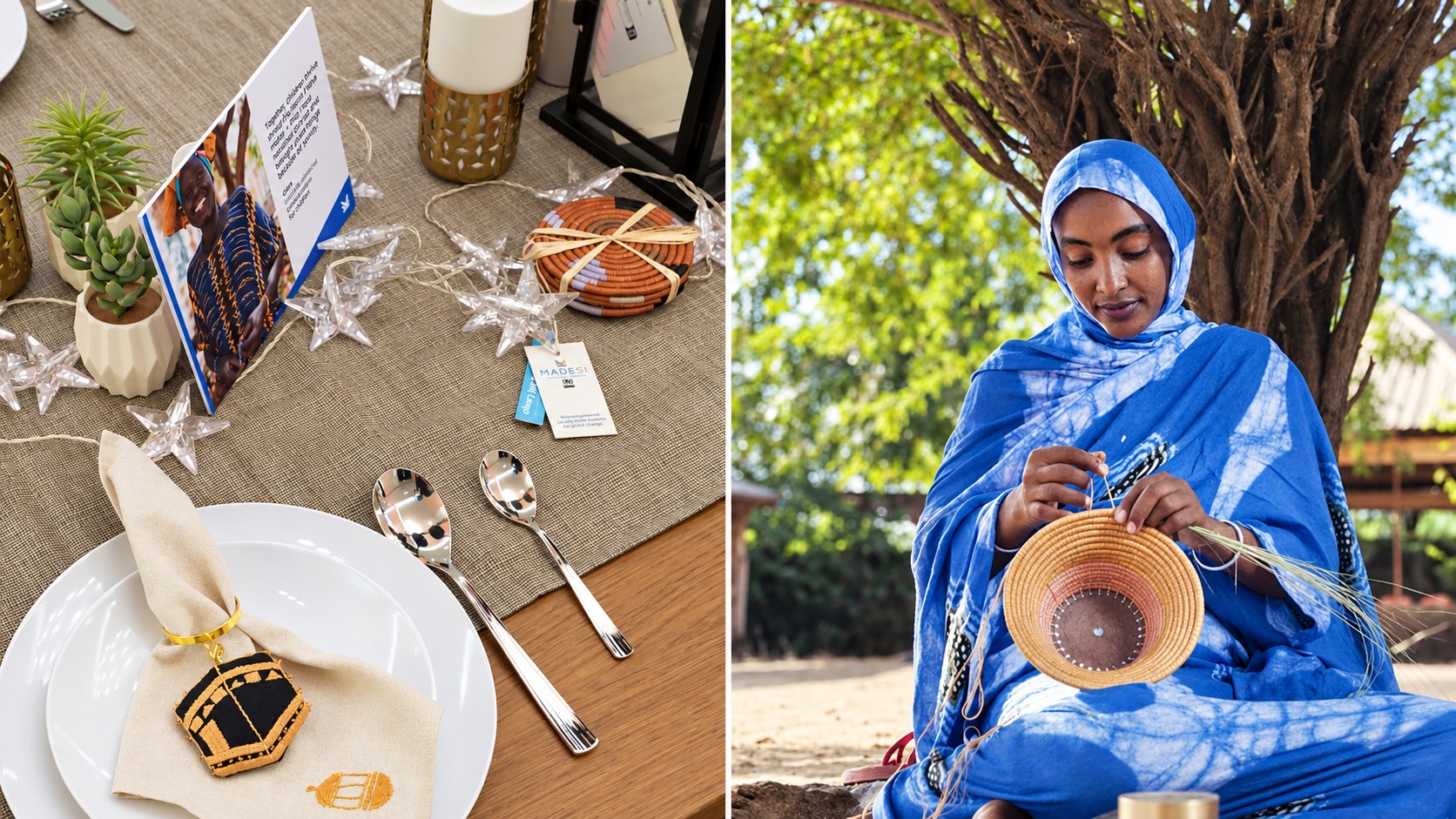


Handcrafted by refugee artisans, MADE51’s products connect traditional skills with paid work and international markets, giving its support for Lei Wa Lakom’s conference in Kuwait a direct link to women’s economic participation.
An embroidered cushion, a leather tassel and a hand-stitched pencil case might seem far removed from a conference about the economy. Behind each, however, are questions central to that discussion: whose skills are recognised, who can reach a paying customer and how work becomes a source of independence.
These are the questions behind MADE51, the UNHCR initiative supporting Lei Wa Lakom’s Women & the Economy conference in Kuwait. Its collection spans home décor, jewellery, accessories and children’s products, made through a network connecting refugee artisans with social enterprises and international buyers.
The connection to the conference runs deeper than the finished objects. Many of the people behind MADE51’s products are women using embroidery, weaving and other inherited skills to earn an income while displaced. Their work offers a practical example of economic participation built around knowledge they already possess, supported by the business relationships needed to bring it to market.
The craft behind everyday objects
Across MADE51’s collection, familiar products carry techniques associated with particular communities and places. The detail is in how they are made: the stitching across a cushion cover, the cutting and binding of leather, or the combination of materials in a piece of jewellery.
The Pukhtadozi cushion in blue, for example, is embroidered by Afghan refugee women living in Pakistan, working with MADE51’s social enterprise partner Artisan Links. Made with linen fabric and cotton thread, it applies embroidery skills passed down through generations to a product intended for contemporary homes.
The same partnership produces embroidered pencil cases that can also be used as small pouches. These are everyday objects, but their construction depends on specialist knowledge. Identifying the makers and their techniques gives buyers a clearer understanding of the labour behind something that might otherwise be judged only by its colour, shape or price.
That distinction matters to MADE51’s approach. The artisans contribute existing expertise, while partner organisations help translate it into products that can be produced, marketed and delivered to customers. Cultural heritage remains part of the finished work rather than being separated from its commercial purpose.
A collection shaped by memory
The initiative’s 2026 Peace Collection makes the relationship between product and personal experience particularly visible. In a feature published on 19 June, MADE51 described two pieces made by artisans from different refugee communities: an embroidered pencil case and a leather tassel keyring.
The Peace Pencil Case is made by Sudanese refugees in Egypt through Threads of Hope. Its embroidery includes a message from Mashaer, a Sudanese refugee artisan, expressing her wish to return to the farms and gardens of home. The object carries an individual’s words through a technique that also provides paid work.
The Peace Tassel Keyring draws on another tradition. Malian refugee women in Niger cut and bind leather to form its tassel, which is finished with a cow horn bead engraved with the word “Peace” in Tamashek. The product brings together leatherwork, metalwork and a reference to the language and heritage of its makers.
Taken together, the pieces show how different the work within one collection can be. Their shared identity comes from the circumstances and skills of the people making them, while their materials and methods remain distinct.
How the products reach buyers
Making an object and bringing it to an international customer involve different kinds of expertise. A skilled embroiderer may still need access to product development, order management, shipping and retail relationships before her work can generate income beyond her immediate community.
UNHCR describes MADE51 as a market-based approach to refugee economic inclusion. It identifies refugees with craft skills, supports artisan groups and connects them with experienced local social enterprises. Those relationships provide the commercial infrastructure around the making process.
The enterprises help with production and market access, while private-sector partners contribute to activities such as design and marketing. The model therefore involves a chain of work extending beyond the artisan’s workshop to the businesses responsible for getting products into shops and customers’ hands.
MADE51 also works with the World Fair Trade Organization on standards governing its partner network. According to its published guidance, local social enterprises pay the artisans, and the initiative reviews payment rates for products in the collection. This makes the terms of production part of the model, alongside the appearance and saleability of the finished piece.
Why the connection to Lei Wa Lakom matters
Lei Wa Lakom’s work in Kuwait centres on opening opportunities for women, including through financial literacy and conversations about their participation in the economy. MADE51’s support for its conference connects that discussion with women whose economic activity takes place in workshops, community spaces and homes across refugee-hosting countries.
The relationship is relevant because financial participation begins in different places. For an artisan, it may start with securing an order, being paid for specialist work and developing a relationship with a business that can bring further commissions. These are concrete parts of an economic life, even when the work happens far from a conventional office.
There is also an established route for organisations to engage with that production. Alongside individual retail sales, MADE51 offers wholesale sourcing, corporate gifts and custom collaborations. Its products can therefore enter business purchasing decisions as well as personal ones, connecting the makers to buyers beyond the usual craft retail audience.
For the Kuwait conference, that provides a tangible connection between the conversation and the work it describes. An embroidered cushion or leather accessory is the finished result of a much longer process involving skill, materials, payment and access to customers. MADE51’s support puts those makers within a discussion of women and the economy, with their products showing exactly what their expertise produces.