


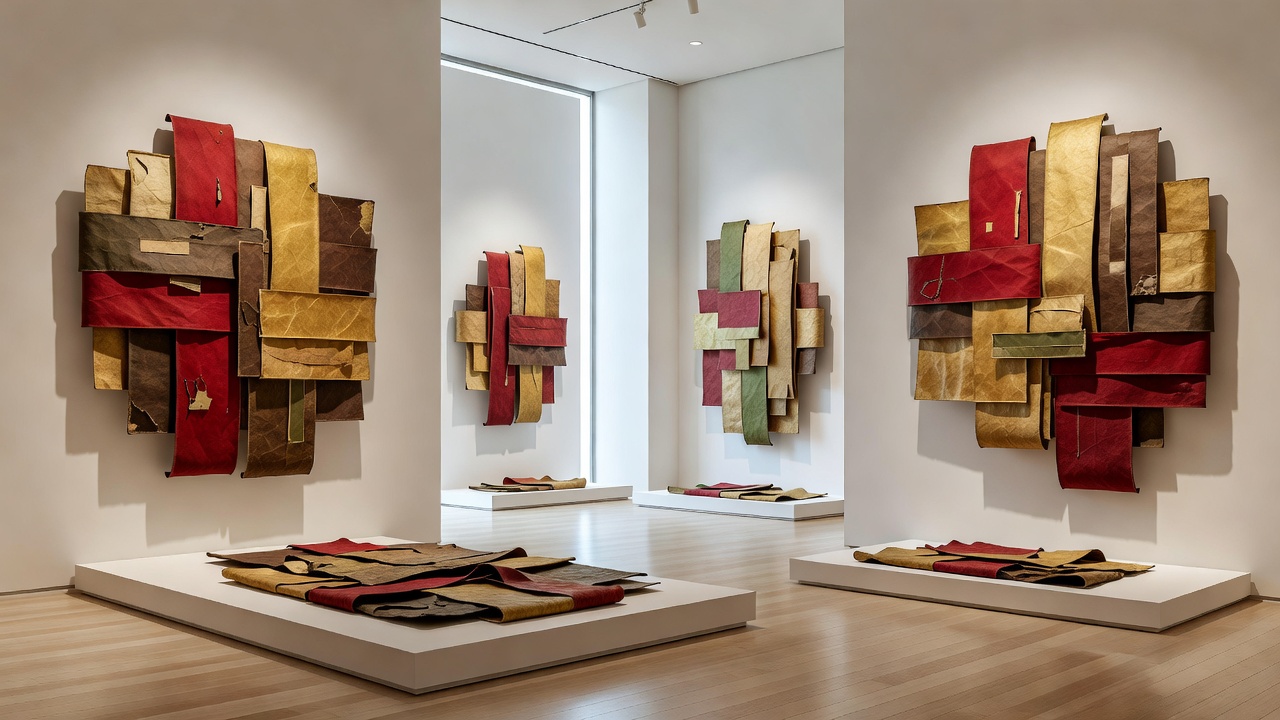


Japanese contemporary artist Takeshi Ikeda presented his solo exhibition TIME WORN at the Isetan Shinjuku Art Gallery, repurposing decorative cigar ribbons into contemporary pieces that retain traces of their former use. The show, which ran from October 7 to October 13, reflected the artist’s conviction that objects acquire deeper significance through handling and time rather than pristine restoration. According to Cigar Journal, the exhibition introduced the visual and historical language of cigar culture to new audiences engaged with contemporary art, fashion, design and luxury.
Ikeda has built his practice around a material long familiar to cigar enthusiasts yet seldom seen in galleries, taking ribbons that typically adorn cigar boxes and are often discarded afterward. He incorporates their irregularities, cuts and accumulated wear into fresh structures instead of attempting to erase signs of prior use. A profile on the JPS Gallery website, which planned the exhibition, places his birth in 1979 and notes his Tokyo base.
An important element of Ikeda’s development has come through collaboration with Cigar Club Tokyo. Cigar Club Tokyo president Maki Nakane has supplied ribbons that serve as core material for the artworks. Ikeda said, “Cigar Club Tokyo’s president Maki Nakane has kindly supported my work by providing cigar ribbons that I use as primary materials in my artworks. Through this relationship, my practice has grown not only within the context of contemporary art, but also within the actual spaces and communities where cigar culture continues to be experienced and passed on.”
The artist’s sustained engagement with Cuba has informed much of his material exploration, given the island’s central place in global cigar production. His works have meanwhile gained presentations and collectors across Asia, including in Hong Kong and Korea alongside his home country of Japan. Cigar Journal reported that these cross-cultural threads have allowed the practice to expand beyond traditional artistic confines.
Ikeda’s family background provided an early foundation for his interest in tobacco culture and textile assembly. His grandmother ran a small tobacco shop, while an uncle and aunt pioneered Japanese patchwork quilting and taught him that stories could be built through fabric. The JPS Gallery profile states that his father worked as a photographer under Ihei Kimura, one of Japan’s most noted lensmen.
The exhibition also introduced the first phase of Ikeda’s new AWAI PROJECT, an archival series that reconfigures photographs, prints and prototype materials from Sachiko Kawabe, a leading figure in Japanese fashion and beauty from 1938 onward. These pieces cut and layer images with transparent film, then add gold thread and copper rivets to create physical tension and partial obscuration. Bijutsu Techo reported that the approach extends the artist’s editing method into personal and cultural histories.
Presented in a prominent department store setting, the show merged cigar heritage with fine art in ways that invited fresh interpretations from diverse cultural sectors. Planning and cooperation came from JPS Gallery, which has supported Ikeda’s exhibitions in recent years. The display closed on October 13 after offering a concise record of how overlooked materials can carry forward narratives of labor, trade and memory.