


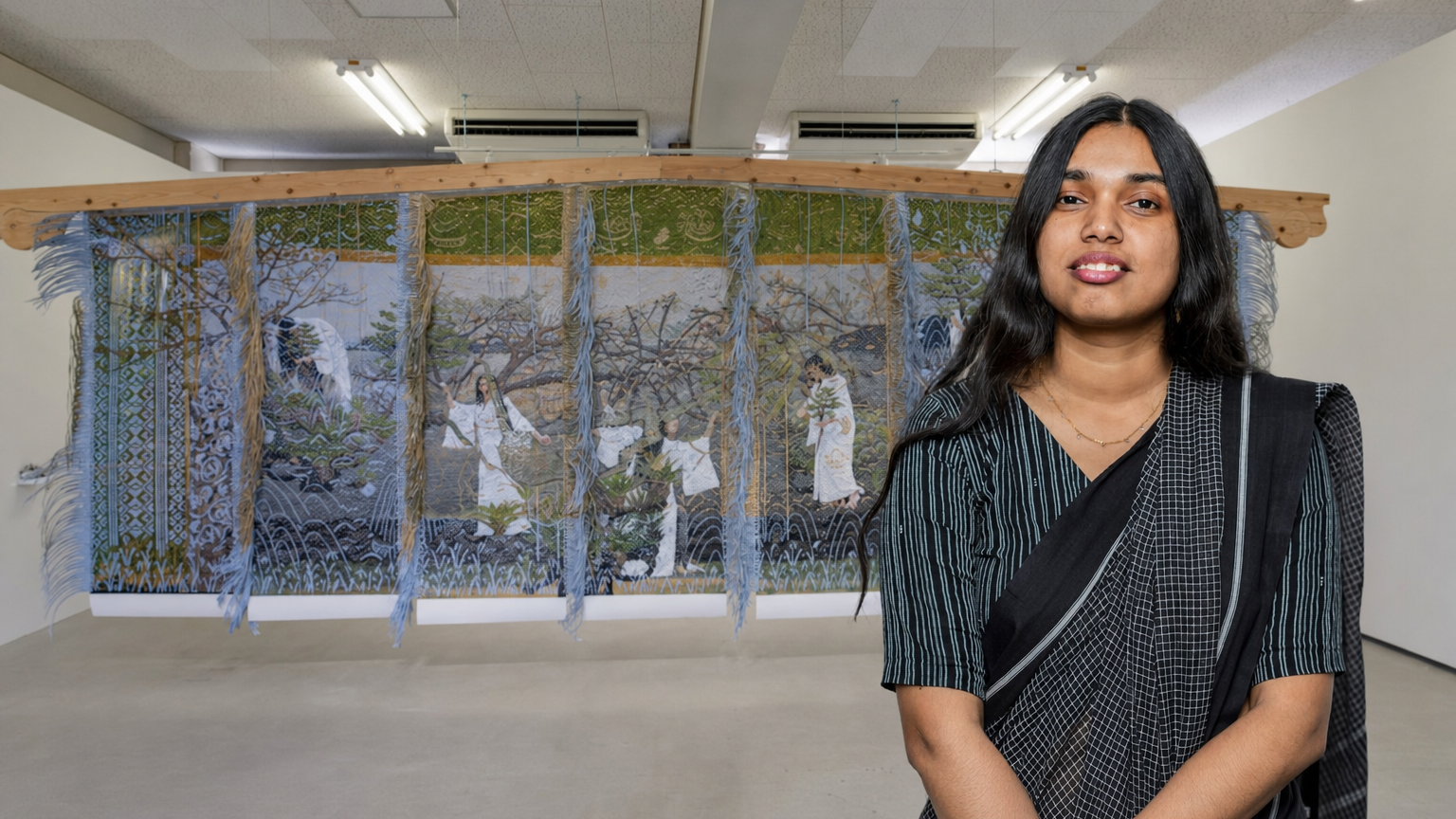


Emami Art announced that Under the Moon Across Many Waters brings together more than a decade of Akhanda’s practice across photography, performance, video, drawing, installation and weaving. Archival photographs, family documents, letters and telegrams appear reimagined throughout the show to mirror the fragmented character of remembrance. The exhibition references specific locations including Comilla, Barishal and Faridpur to link personal stories with wider histories of displacement after the 1947 Partition of Bengal.
Open Magazine reported that Akhanda’s childhood spent in Cuttack rather than visiting her ancestral village in Bangladesh created an early sense of rootlessness that drives her current work. The artist has cited the embroideries, crochet and kanthas made by both grandmothers together with her grandfather’s activities as an artist and poet as her first inspirations. “Both my paternal and maternal grandmothers created intricate embroideries, crochet, and kanthas,” Akhanda told the magazine.
Akhanda received the Sovereign Asian Art Prize in 2025 for her woven piece Dendritic Data lb, according to coverage in Mint Lounge. She treats paper in these works to evoke the texture of tapestry, allowing the warp to stand for institutional historical records and the weft for intimate individual narratives. This process creates space for overlooked voices and challenges established accounts of the past, the artist has stated in multiple interviews.
Vogue India described how Akhanda’s engagement with family archives began with performances such as The Living Scars in which she marked maps of the Partition onto her arms. The ongoing series Hath-Pakha collects oral histories from the women in her family who migrated during or after Partition. These pieces underscore the ephemeral quality of memory and the function of everyday objects in safeguarding what might otherwise disappear.
Akhanda’s official website lists participation in exhibitions at Autograph in London and a residency at Jester in Genk, Belgium, following her 2017 MFA from Visva Bharati University in Santiniketan. The Emami Art presentation remains on view until December 26. Platform Magazine noted that her method of collecting memories through art offers a way to preserve elements of history at risk of dilution within larger national narratives.